Do Metatarsal Pads Work for Morton's Neuroma?
In contrast to the trending self-care methods, the use of metatarsal pads is a conventional method that we commonly prescribe for foot pain at Pro Foot Doctors clinic. Metatarsal pads can provide relief when applied correctly, as they relieve pressure from inflamed nerves. However, this remedy is not always effective, and their effectiveness varies between patients and depends on proper sizing, anatomical structure, and accurate pad placement.
What Morton's Neuroma Actually Is?
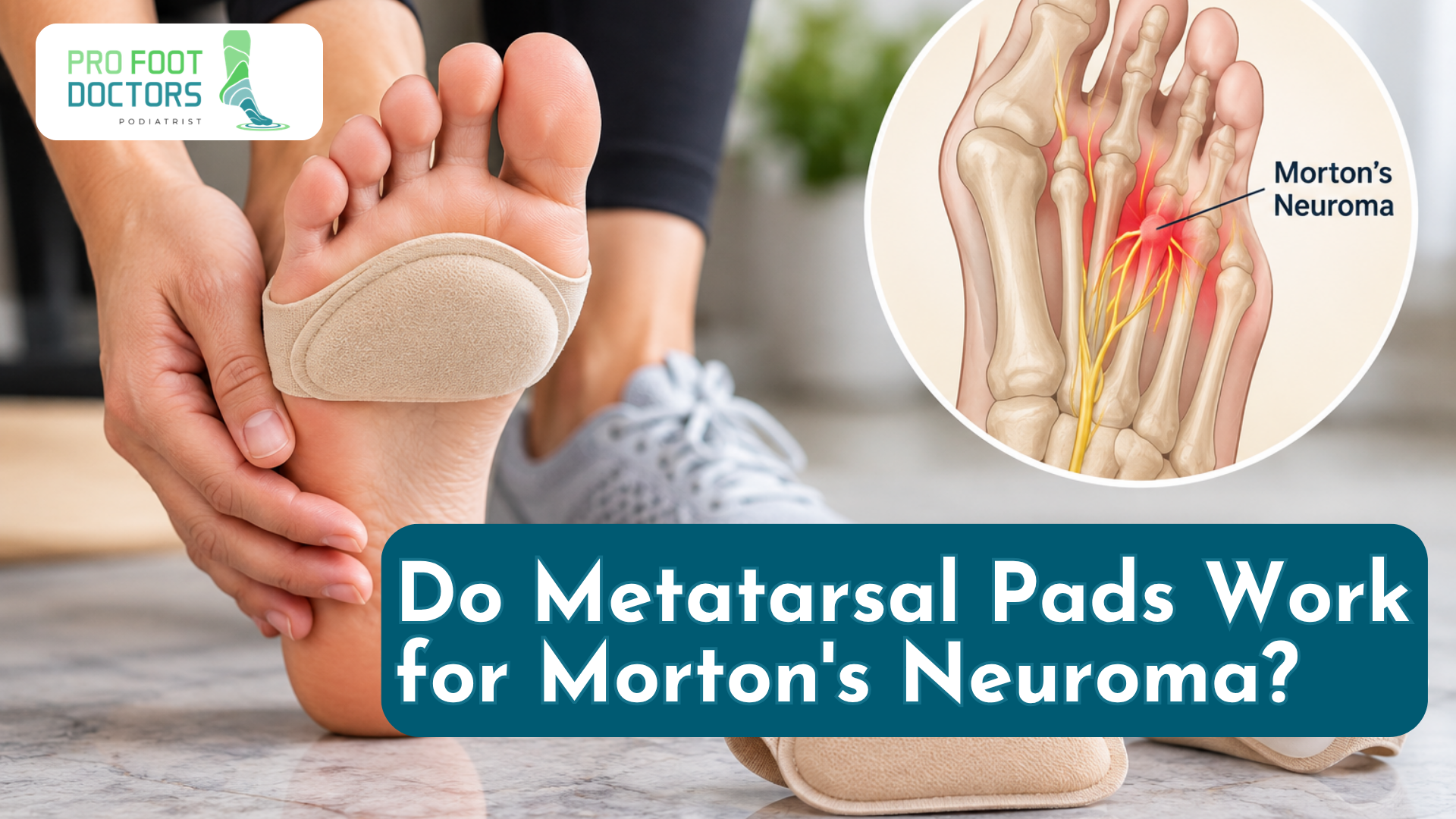
It is a perineural fibrotic thickening of the tissue surrounding the intermetatarsal plantar nerve most commonly affecting the third common plantar digital nerve between the third and fourth toes. Mechanical pressure applied to the area by narrow footwear or repeated impact can lead to localized pain and burning in the ball of the foot.
How Metatarsal Pads Work?
Metatarsal Pads provide pain relief for nerves via off-loading mechanisms and not from healing of the tissues. First, the pad needs to be placed slightly posterior to the ball of the foot (proximal to the metatarsal heads) and not under the irritated area.
By elevating the metatarsal shafts, the pad helps redistribute weight-bearing forces away from the metatarsal heads, reducing direct mechanical pressure on the compressed intermetatarsal nerve to create space between the toes, and hence relieving pressure on the compressed intermetatarsal nerve. This helps relieve physical irritation while walking even without shrinking the actual size of the nerve.
What the Clinical Evidence Shows?
Research shows that the use of metatarsal padding and specially adapted shoes should be considered a first-line conservative treatment for Morton's neuroma.
It has been shown in research examining conservative treatments that an appreciable proportion of patients are able to alleviate their symptoms partially to completely through modifications of orthotics, wearing broad toe-box shoes, and specific padding alone.
According to clinical research conducted and published in Foot & Ankle International, although conservative shoe modification and orthotic treatments are effective at alleviating symptoms, corticosteroid injections can provide pain relief and reduce inflammation.
Although metatarsal pads are helpful for reducing pain on a daily basis, they are a treatment method and not a sure solution for all patients.
Why Placement Makes or Breaks the Result?
The correct anatomical placement is a crucial factor that determines whether metatarsal pads offer relief or add more pain to the patient's condition. By placing a pad proximal to the metatarsal heads, it assists in redistributing pressure away from the forefoot region during movement.
However, when the pad is located distally, directly under the metatarsal heads or toes, it leads to excessive pressure being placed on the ball of the foot area, thus worsening nerve irritation. The opposite case, where the pad is located distal to the metatarsal heads, causes the inability of the pad to interact with the forefoot region.
In addition, the choice of material and pad thickness play an important role in the comfort factor: a very thick pad reduces the space in the shoe and creates pressure, whereas an excessively soft pad loses its thickness too fast.
Custom Pads vs. Over-the-Counter Options
Starting with an off-the-shelf insert can be a reasonable starting point, but clinical customization offers distinct advantages.
| Feature | Over-the-Counter Pads | Custom Podiatric Orthotics & Pads |
| Placement | Adhesive backing placed manually by trial and error. | Our podiatrist marks precise anatomical placement directly on the insert. |
| Stability | May shift inside the shoe during activity. | Can be incorporated into or under a custom-molded orthotic base. |
| Best Used For | Initial trial, mild symptoms, or flexible footwear. | Moderate-to-severe symptoms, unusual foot structures, or persistent pain. |
What to Do If Metatarsal Pads Aren't Enough?
If all the above padding and footwear modification is not effective in alleviating your condition, there are further medical treatment options that can be considered:
- Footwear Revision: Consider wearing shoes with a wide toe box and flat heel, in order to avoid transverse pressure on the forefoot area.
- Corticosteroid Injection Therapy: We can inject steroids into the painful area to relieve local inflammation of the nerve.
- More Advanced Treatments: Further treatments like orthotics, alcohol injection therapy, and radiofrequency ablation can be considered to alleviate the problem of forefoot pain.
- Surgical Considerations: When conservative measures do not provide adequate relief, surgical options (such as nerve decompression or excision) may be discussed with our podiatrist as a secondary consideration.
How to Use Metatarsal Pads Correctly?
Here are some tips to ensure maximum comfort and efficiency:
- Pad Selection: Apply the metatarsal pad to the footwear of the affected foot, unless our podiatrist specifically advises bilateral use.
- Locate the Placement Area: Identify the bony prominences at the ball of your foot and place the highest point of the pad just proximal (behind) these joints toward your heel.
- Track Your Progress: Monitor your response over a few days to a couple of weeks. If pain persists or worsens, stop readjusting the pad and schedule an evaluation with our podiatrist.
When to See The Podiatrist?
Reach out to our podiatrist immediately if you notice:
- Pain that persists or worsens despite accurate pad placement and supportive footwear.
- Numbness, tingling, or burning sensations radiating into your toes.
- Swelling, severe forefoot tenderness, or pain that interferes with daily walking.
- Any forefoot symptoms at all if you have diabetes or a condition affecting circulation, as unintended pressure points can lead to skin breakdown or non-healing ulcers.
Find Real Relief for Forefoot Pain
Metatarsal Pads are a good conservative treatment option and non-invasive; however, proper positioning is key to whether or not it will work for you. If OTC devices have not helped with your nerve pain, Pro Foot Doctors can fit you with proper options.
In case you are experiencing forefoot pain and are not sure of its cause, our podiatrists from Pro Foot Doctors would be glad to evaluate it.